

The Auction Success Formula
A successful auction comes down to a simple equation: qualified buyers competing for the same property. Without competition, auctions fizzle. Without qualification, bidders drop out before the price reaches where it needs to be. The agent's job in the weeks leading up to auction is to build both.
Many agents focus primarily on the property itself during the campaign period-photography, descriptions, inspections. But equally important is the work of finding buyers and motivating them to compete. A stunning property with no bidders produces a passed-in result.
This is where targeted advertising proves its value. Rather than hoping the right buyers discover your listing, you actively seek them out and draw them toward your auction.
The Compressed Timeline Challenge
Auction campaigns typically run for four weeks, sometimes less. That's a compressed timeline to find qualified buyers, get them through inspections, help them complete due diligence, and build enough interest that they're ready to compete publicly.
Every day matters in an auction campaign. Delays in reaching the right buyers mean less time for relationship building and qualification. Starting your advertising early-ideally before day one of the public campaign-gives you maximum runway.
The most successful auction agents front-load their advertising effort. Heavy investment in the first two weeks builds awareness and generates initial interest. Sustained presence in weeks three and four maintains momentum as auction day approaches.
Build a complete real estate campaign in under 15 minutes.
AdPropix turns a single listing URL into a launch-ready campaign across Google, Microsoft, Facebook and Instagram - with hyper-targeted geo audiences, 1,500+ on-brand templates and vendor-paid reporting built in.
Building a Qualified Buyer Pool
Numbers alone don't make a successful auction-you need qualified buyers ready to compete. This means people who've inspected the property, understand its value, have their finances in order, and are emotionally invested in winning.
Advertising brings awareness; inspections and follow-up build qualification. Your campaigns should focus on driving inspection attendance and capturing buyer details that enable follow-up.
Pre-auction campaigns should generate three types of response: inspection registrations, information enquiries, and contract requests. Each response type indicates a different level of interest and helps you gauge the building buyer pool.
Creating Competitive Energy
Buyers bid more confidently when they believe others are interested. Conversely, if a buyer thinks they're the only serious contender, they'll lowball their offer. Creating perceptible competitive energy benefits your vendor.
Regular advertising during the campaign period signals activity and interest. Buyers seeing consistent presence from your listing assume (often correctly) that others are also watching. This social proof encourages more serious engagement.
Updates during the campaign can reinforce competition. "Strong interest from qualified buyers" and "multiple inspections completed" are statements that, when true, signal a competitive process.
The Final Week Push
As auction day approaches, your advertising should intensify rather than wind down. The final week is when fence-sitters need a push, when undecided buyers need a reason to commit, when the importance of the deadline becomes real.
Urgency messaging works powerfully in the final days. "Auction this Saturday" and "Last chance to inspect" create the time pressure that motivates action. Buyers who've been casually interested are forced to decide whether they're really in or out.
Final week advertising should reach not just your established audience but expand to capture late-arriving buyers. Sometimes the winning bidder only discovers the property in the last few days-make sure you're still fishing in fresh waters.
Backup Buyer Strategy
Not every buyer at your auction will win, but losing bidders are some of the most valuable leads you can generate. They're qualified, motivated, and ready to purchase-they just need the right property.
Capturing details from auction attendees and registered bidders enables post-auction follow-up. The buyer who narrowly missed out today might be perfect for your next listing. The underbidder from one auction becomes the successful purchaser at another.
This is one reason auction campaigns can be so valuable even when the property doesn't sell under the hammer. The buyer database you build serves your business for months after the campaign ends.
Measuring Auction Campaign Success
Beyond the auction result itself, there are intermediate metrics that indicate whether your advertising is working. Inspection numbers, enquiry volume, contract downloads, and bidder registrations all provide insight before auction day arrives.
Track these metrics throughout the campaign. If inspection numbers are lagging in week two, you know to adjust your advertising. If enquiries are strong but contract requests are weak, you might need to address buyer concerns more directly.
Post-auction analysis helps improve future campaigns. What worked? What didn't? Which targeting approaches produced the strongest buyer interest? This learning compounds over time.
Supporting Vendor Confidence
Vendors in an auction campaign experience anxiety that agents sometimes underestimate. They've committed to a public process with an uncertain outcome. Regular updates about buyer activity help manage that anxiety.
When your advertising generates inspections, enquiries, and bidder registrations, share that progress with your vendors. Visible marketing activity provides reassurance that everything possible is being done to achieve a strong result.
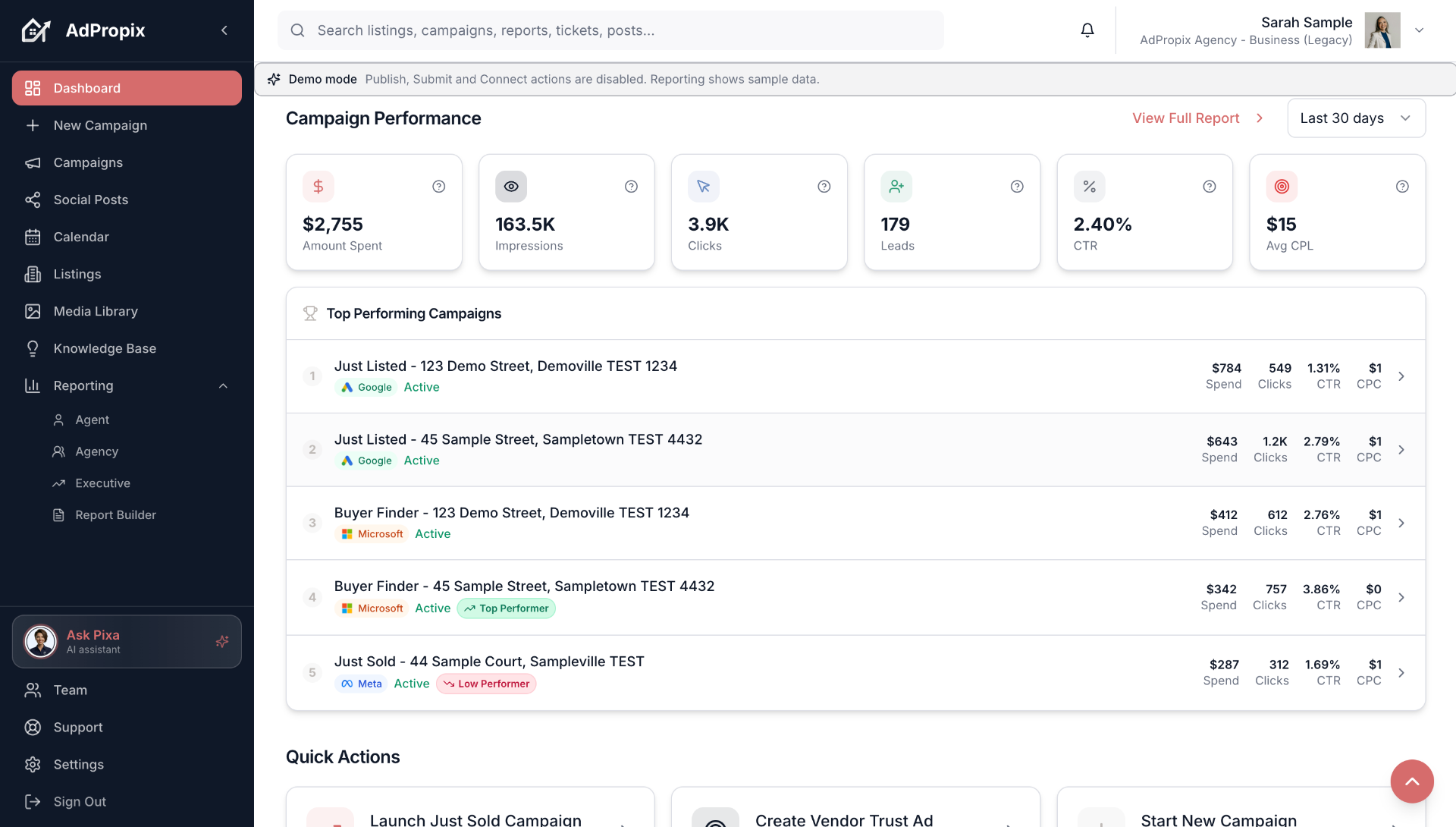
Platforms like AdPropix provide campaign reports that can be shared with vendors, showing reach, engagement, and response metrics. This transparency builds trust and demonstrates professionalism.
Frequently asked questions
What is the fastest way for a real estate agent to building buyer competition for auction properties?
Paste a listing URL into AdPropix. The platform extracts your brand DNA, builds suburb-of-focus geo audiences, renders every ad size across Google, Microsoft, Facebook, Instagram and TikTok, and configures tracking - a complete campaign in under 15 minutes, engineered by real estate digital marketing experts.
How does AdPropix help with auction property advertising?
AdPropix is a purpose-built real estate marketing platform. It handles auction property advertising end-to-end: brand-locked creative, hyper-targeted audiences, paid + organic distribution, vendor-paid reporting and CRM sync - all from a single listing URL or CRM-synced property.
How long does it take to set up auction property advertising on AdPropix?
Under 15 minutes from listing URL to launch-ready, multi-channel campaign. The 14-day free trial requires no credit card, and complete vendor-paid reporting is built in.
Put this into practice with AdPropix
Stop stitching tools together. Paste a listing URL and AdPropix produces a complete, on-brand campaign with expert-grade targeting in under 15 minutes - across Google, Microsoft, and social.
60 seconds to start. No card required.


